

Table of Contents
- What Makes the Best Cotton Fabric for Graphic Tees
- Ring-Spun vs. Combed Cotton for Printing
- The Best T-Shirt Fabric Weight for Screen Printing
- Pima, Supima, and Organic Cotton: Premium Options
- Tri-Blend vs. CVC: Blends That Change the Print
- Durability, Shrinkage, and Color Retention
- How to Wash Graphic Shirts Safely
- Conclusion
- Frequently Asked Questions
Last Updated: September 28, 2026
What Makes the Best Cotton Fabric for Graphic Tees
The best cotton fabric for graphic tees balances three things: a smooth print surface, enough weight to hold ink without sagging, and a fiber structure that survives repeated washing. Get them right and a graphic tee looks sharp for years; get them wrong and the print cracks within a dozen cycles.
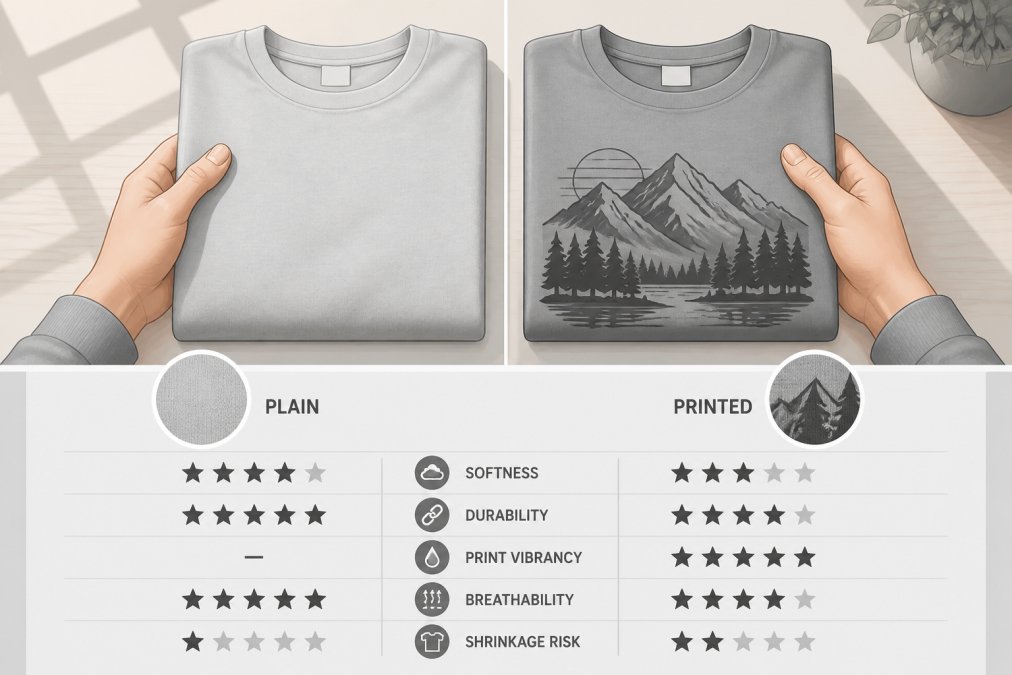
The biggest mistake shoppers make is chasing softness alone.
100% Cotton vs. Cotton Blends
100% cotton is woven entirely from cotton fiber, with no synthetic content. It takes plastisol and water-based inks cleanly, breathes well, and holds color on natural and pigment-dyed garments.
Understanding Ring-Spun Cotton
Ring-spun cotton is twisted and thinned repeatedly during spinning, producing a finer, stronger, smoother yarn. The extra processing removes short fibers and aligns the long ones, which is why ring-spun tees feel softer and print with cleaner edges.
Ring-Spun vs. Combed Cotton for Printing
Ring-spun cotton produces a smoother print surface than combed cotton because its finer, more tightly twisted yarns leave fewer irregularities for ink to sink into. That matters most with detailed linework and small text.
Here's how the two compare in practice:
Fabric |
Surface Smoothness |
Ink Absorption |
Best For |
Cost |
|---|---|---|---|---|
Ring-spun cotton |
High, fine yarn |
Even, controlled |
Detailed graphics, soft hand-feel |
Higher |
Combed cotton |
Medium |
Moderate |
Simple logos, budget runs |
Moderate |
Carded cotton |
Lower, coarser |
Uneven |
Basic single-color prints |
Lowest |
The Best T-Shirt Fabric Weight for Screen Printing
The best t-shirt fabric weight for screen printing sits between 5.0 and 6.5 oz per square yard for most designs, with 5.3 to 5.5 oz the sweet spot for everyday wear. Heavier fabrics hold large ink deposits without distortion; lighter ones feel cooler but can pucker under thick prints.
GSM and Fabric Weight Explained
GSM stands for grams per square meter, the metric measure of fabric density. It's the number on supplier spec sheets, and it tells you more about a tee's body than the ounce rating alone.
- Lightweight: roughly 145-160 GSM, thin and breezy
- Midweight: roughly 170-190 GSM, the everyday standard
- Heavyweight: roughly 200+ GSM, structured and opaque
Pima, Supima, and Organic Cotton: Premium Options
Pima cotton is a long-staple fiber grown for extra length and strength, producing a smoother, more durable yarn. Supima is the trademarked certification for American-grown Pima, guaranteeing fiber purity and origin.
Tri-Blend vs. CVC: Blends That Change the Print
Tri-blend and CVC behave very differently from pure cotton, and the difference shows up in the print. The real decision point is ink chemistry: polyester and rayon content change how plastisol, water-based, and discharge inks cure, adhere, and age.
Fabric |
Plastisol |
Water-Based |
Discharge |
DTG |
|---|---|---|---|---|
100% ring-spun cotton |
Excellent |
Excellent |
Excellent |
Good |
CVC (60/40 cotton/poly) |
Very good |
Good |
Poor |
Fair |
Tri-blend (cotton/poly/rayon) |
Fair |
Poor |
Not suitable |
Poor |
50/50 cotton/poly |
Good |
Fair |
Not suitable |
Fair |
Fabric Sourcing for Small-Batch Creators
If you're an independent designer ordering 50 shirts rather than 5,000, the blend question gets more practical. Most mills sell tri-blend and CVC by the roll with minimums small shops can't meet, so most small-batch creators buy blanks, finished, pre-shrunk tees from a wholesaler, and print on those. Check the fiber content on the spec sheet before you commit: a "cotton-rich" label can mean anything from 52% to 80% cotton, and that range changes which inks your printer can use.
Durability, Shrinkage, and Color Retention
Fabric weight and fiber length drive durability more than any marketing claim. Heavier, long-staple cotton resists thinning and pilling; lighter, short-staple cotton breaks down faster. But the difference between carded, combed, and ring-spun cotton only shows up after repeated washing, which is why most buying guides, written from spec sheets rather than laundry rooms, skip it.
Be A Good Human Unisex Softstyle →
Long-Term Wash Testing: What 20+ Cycles Reveal
A spec sheet tells you what a fabric is; a wash test tells you what it becomes. Here's the pattern across cotton grades after roughly 20 wash-and-dry cycles:
Fabric |
Pilling After 20 Washes |
Shrinkage (hot wash/dry) |
Print Edge Integrity |
Color Fade |
|---|---|---|---|---|
Carded cotton |
Heavy at underarms, side seams |
5-7% length |
Fuzzy, slightly blurred |
Noticeable at shoulders |
Combed cotton |
Light, high-friction areas |
4-6% length |
Mostly crisp |
Mild |
Ring-spun cotton |
Minimal |
3-5% length |
Crisp |
Minimal |
CVC (60/40) |
Minimal |
2-4% length |
Crisp |
Minimal |
Tri-blend |
Minimal pilling, but distortion |
3-6%, uneven |
Can distort out of register |
Moderate, heathered look masks it |
How to Wash Graphic Shirts Safely
Washing graphic shirts safely comes down to three rules: cold water, inside out, and low heat. Heat destroys prints, not detergent.
- Turn the shirt inside out before washing to protect the print from friction
- Wash in cold water, max 30C or 90F, with similar colors
- Skip bleach and fabric softener, both degrade ink and fiber
- Tumble dry on low heat, or hang dry when you can
- Never dry clean a printed cotton tee
Conclusion
Choosing the best cotton fabric for graphic tees comes down to matching fiber, weight, and ink to how the shirt will be worn. Ring-spun midweight cotton handles most graphics best, long-staple options hold up longer, and blends trade printability for wrinkle resistance.
Frequently Asked Questions
What is the best fabric to use for graphic tees?
Ring-spun cotton is the best all-around choice for graphic tees. Its longer, tighter-twisted fibers create a smoother surface that holds ink well and resists pilling. For a softer, more premium feel, Pima or Supima cotton works well. If you need moisture-wicking or stretch, a tri-blend or CVC fabric performs better. The right pick depends on your printing method and how you want the shirt to feel.
Is Pima cotton better than 100% cotton?
Pima cotton is 100% cotton, just a higher grade with longer fibers. Those longer fibers make Pima softer, stronger, and less likely to pill than standard cotton. It also takes dye and ink more evenly. The trade-off is cost. For everyday graphic tees, ring-spun cotton offers a similar feel at a lower price. Pima makes sense when you want a noticeably softer, longer-lasting shirt.
How does fabric weight affect graphic tee durability?
Fabric weight, measured in GSM or ounces per square yard, affects how a tee drapes, wears, and holds a print. Lightweight fabrics (around 4.0 to 4.5 oz) feel airy but can stretch and show wear faster. Midweight (5.0 to 5.5 oz) balances comfort and durability. Heavyweight (6.0 oz and up) resists shrinkage and holds shape longer. For screen printing, midweight ring-spun cotton is the most forgiving.
Why choose ring-spun cotton over carded cotton for graphic apparel?
Ring-spun cotton goes through extra spinning and combing that removes short fibers and aligns the remaining ones. The result is a smoother, stronger yarn with better hand-feel. Carded cotton skips that step, so it feels rougher and pills faster. For graphic apparel, ring-spun cotton gives you a cleaner print surface, better ink absorption, and a shirt that stays soft after repeated washes.
How do I wash graphic shirts safely to protect the print?
Turn the shirt inside out before washing. Use cold water on a gentle cycle with similar colors. Avoid bleach and fabric softener, which break down the ink. Tumble dry on low heat or hang to dry. If you iron, do it on the reverse side and never directly on the graphic. Following these steps keeps the print from cracking or fading for years.
What GSM is best for screen printing on t-shirts?
Most screen printers work with fabrics between 4.5 and 6.0 oz per square yard, which is roughly 150 to 200 GSM. That range gives the ink a stable surface without soaking through. Heavier fabrics (6.0 oz and up) handle thick plastisol inks well and resist stretching during the print process. Lighter fabrics work for water-based and discharge printing but require more care to avoid ink bleed.
Do cotton blends last as long as 100% cotton graphic tees?
Blends like CVC (chief value cotton) or tri-blend (cotton, polyester, rayon) can outlast 100% cotton in some ways. Polyester adds strength and resists shrinking, while rayon adds drape. The catch is that blends absorb ink differently. Plastisol sits on top of the fabric, so it adheres well to blends. Water-based inks need cotton-rich fabric to bond properly. For longest print life on a blend, plastisol or DTG works best.
What should I look for in a high-quality graphic tee?
Check the fabric composition first. Ring-spun or combed cotton beats carded cotton. Look for a weight between 5.0 and 6.0 oz for everyday wear. Side-seamed construction holds shape better than tubular. Shoulder tape and double-needle stitching add durability. Pre-shrunk fabric means less surprise after the first wash. A garment-dyed finish like Comfort Colors gives a softer feel and richer color from the start.