

Table of Contents
- The Economic Impact of Small Businesses on Your Community
- Why Family Owned Businesses Are the Backbone of Local Character
- How to Find Independent Clothing Brands That Match Your Values
- Why Choose Handmade Over Mass-Produced Apparel
- Generational Legacy and the Digital Shift in Family Businesses
- How Supporting Family Owned Businesses Strengthens Community Resilience
- Frequently Asked Questions
Last Updated: September 28, 2026
The Economic Impact of Small Businesses on Your Community
Choosing where to spend your money is a vote for the kind of place you want to live in. At Taylor's Expressions, a mom and daughter-owned shop, we see that choice play out every day. When you ask why support small family owned businesses, the answer starts with what happens after the sale: the money stays closer to home, recirculating through neighbors, suppliers, and local wages. That is the practical case for family owned businesses, and it is stronger than most shoppers realize.
The multiplier effect describes how money spent with a local business is re-spent nearby, creating additional economic activity.
The Multiplier Effect: Where Your Money Actually Goes
Trace a single purchase. You buy a gift from a family-run shop. The owner pays a local printer, restocks from a regional supplier, and covers staff wages. Those people then spend in the same community. At a national chain, a larger share of the margin leaves for a distant headquarters.
You can see the mechanism in three places:
- Procurement. Locally owned businesses are more likely to use local accountants, printers, contractors, and suppliers, because the owner lives in the same market.
- Payroll. Wages paid to local staff get spent at local grocery stores, schools, and service providers.
- Profit retention. When the owner lives in the community, profit stays there instead of going to shareholders elsewhere.
Job Creation and Wealth Retention
Small businesses are a primary engine of job creation, and locally owned firms keep wealth retention higher because profits stay with residents rather than flowing to outside shareholders. That matters for economic stability: a community with a diverse base of small employers is less exposed when one large employer downsizes.
Why Family Owned Businesses Are the Backbone of Local Character
Walk down a main street and you can feel the difference between a strip of identical franchises and a row of independent shops. That difference is local character, and family owned businesses usually create it. Owners choose the paint, the playlist, the products, and the way they greet you, choices that add up to a place that feels like somewhere, not anywhere.
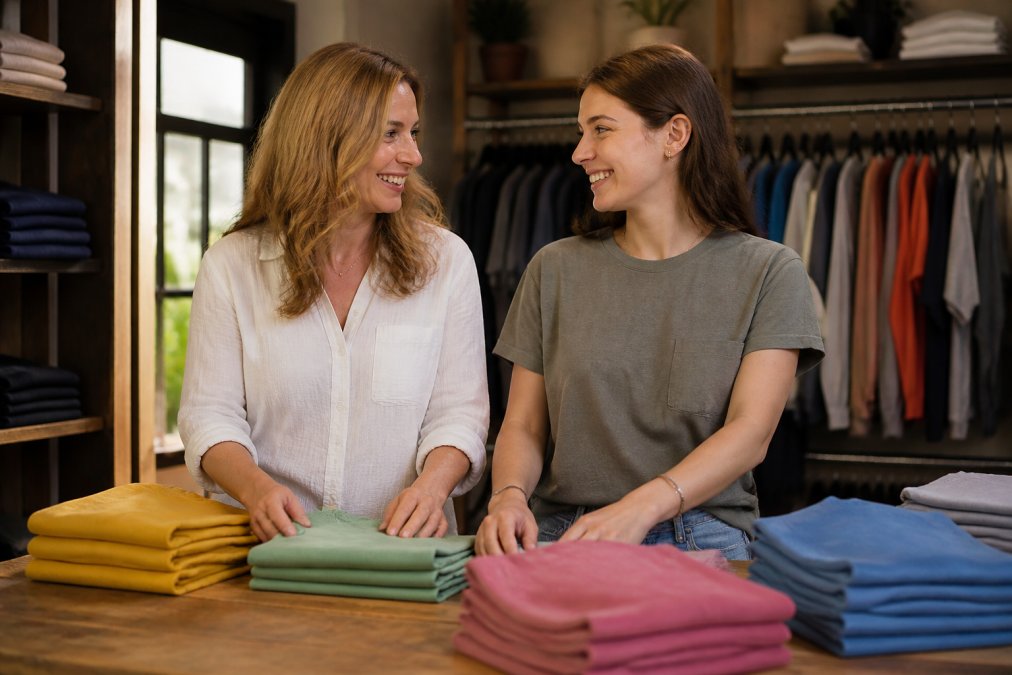
Personalized Service You Won't Find at Big Box Stores
Personalized service is the clearest everyday advantage of shopping with a family-run business. The person behind the counter has a stake in the outcome and the freedom to solve your problem on the spot, help finding the right size, a recommendation that actually fits, and a face you recognize next time.
How to Find Independent Clothing Brands That Match Your Values
Finding independent clothing brands takes a little more effort than scrolling a marketplace, but the payoff is a wardrobe that reflects what you actually believe. Start with a shortlist of what matters to you, then check whether a brand can back up its claims. Social responsibility and local sourcing are easy to say and harder to prove, so look for specifics.
What to Look For in a Family-Run Shop
- A named owner or family you can identify, not just an anonymous brand
- A clear story about who makes or designs the products
- Specifics on materials, sourcing, or production rather than vague slogans
- Responsive customer service you can actually reach
- Real reviews and a stated return policy
- A local or regional presence you can verify
A shop that answers these questions plainly is usually the real thing. A shop that dodges them is usually not.
How to Tell Family-Owned From Franchise-Owned
This is the step most shoppers skip, and it changes where your money lands. A franchise is a locally operated storefront that pays fees and royalties back to a parent company. The person behind the counter may be a neighbor, but a meaningful share of revenue leaves the area as franchise fees, ad-fund contributions, and required supplier purchases. That is not a knock on franchisees, they are small business owners too, but it is a different economic story than a family-owned shop where the owners set their own prices, choose their own suppliers, and keep the profit.
Taylor's Expressions Gift Card →
A few practical tells:
- Uniform branding across states. Identical signage, menus, and packaging in every market usually signals a franchise or corporate chain.
- A corporate 'locations' page. If the brand's website lists hundreds of stores under one logo, you are looking at a chain or franchise system, not a family operation.
- Who answers the phone. A family-run shop often has the owner or a family member on the line. A franchise typically routes you to a call center.
- Where the 'about' page leads. A real family business usually names the family. A franchise's about page describes the brand, not the people.
- Ask directly. "Is this location family-owned, or is it a franchise?" is a fair question, and most owners are happy to answer it.
How to Shop Family-Owned on a Budget
Supporting family-owned businesses does not require spending more. It requires spending differently. A few approaches that work:
- Buy fewer, better items. One well-made family-owned piece that lasts three seasons often costs less per wear than three fast-fashion replacements.
- Shop the sales cycle. Small shops run end-of-season markdowns, sample sales, and holiday promotions just like chains, sign up for their email list to catch them.
- Start with accessories and gifts. T-shirts, hats, candles, and small goods are the lowest-cost entry point into a family-owned shop.
- Use gift cards strategically. A gift card to a local shop keeps dollars in the community and gives the recipient a reason to walk in.
- Bundle shipping. Many small shops offer free or flat-rate shipping above a threshold, so combining items into one order can beat per-item costs.
- Ask about local pickup. If you live nearby, pickup often removes shipping cost entirely.
Why Choose Handmade Over Mass-Produced Apparel
Choosing handmade or small-batch apparel often means better construction, more distinctive design, and a purchase that supports a real person rather than a production line. Mass-produced clothing wins on volume and price. Small-batch apparel wins on business longevity and meaning, because the maker has a reason to stand behind the work. When you buy from a family-run shop, you are often buying a product the owner would wear themselves.

| What You're Choosing | Mass-Produced | Handmade / Small-Batch |
|---|---|---|
| Price per item | Lower | Higher |
| Design uniqueness | Widely repeated | Distinctive |
| Who profits | Distant shareholders | Local owners |
| Customer service | Scripted, centralized | Personal, direct |
| Environmental footprint | Higher volume, more waste | Smaller runs, less waste |
| Long-term community impact | Limited local benefit | Strong local benefit |
Generational Legacy and the Digital Shift in Family Businesses
Family owned businesses carry something a chain cannot: a generational legacy. Many are passed from one generation to the next, and that continuity is why they care about reputation and community investment. A business you plan to hand to your kids is one you run carefully.
How Supporting Family Owned Businesses Strengthens Community Resilience
Community resilience is what a place has left when times get hard: neighbors who know each other, institutions that hold, and an economy that is not dependent on a single employer. Family owned businesses build all three. They create economic diversity by filling niches a large chain ignores, and that diversity is a form of insurance for the whole area.
Frequently Asked Questions
Why should people support small businesses instead of big box stores?
When you spend $100 at a local family owned business, roughly $68 stays in your community compared to just $43 at a chain retailer, according to the American Independent Business Alliance. That money funds local jobs, infrastructure, and services. Family owned businesses also pay local taxes that directly support schools, roads, and emergency services in your area.
How do family owned businesses contribute to job creation?
Small businesses employ about 46% of the private workforce in the United States, per the U.S. Small Business Administration. Family owned businesses often hire locally and retain employees longer, which builds economic stability. They also tend to reinvest in training and promote from within, creating career paths that keep talent in the community rather than sending it elsewhere.
How can I tell if an independent clothing brand is truly family owned?
Look for a named founder story on their website, behind-the-scenes photos, and details about who runs the operation. Family owned businesses often mention their family members by name in product descriptions or About pages. You can also check if they respond personally to customer questions. Brands like Taylor's Expressions openly share that they are mom and daughter owned, which makes it easy to verify.
What is the difference between handmade and mass-produced clothing?
Handmade and customizable apparel is produced in smaller batches with more attention to detail, so prints and stitching hold up better over time. Mass-produced items are made to hit a price point, often using thinner materials and faster production methods. Choosing handmade means you get a unique item and your purchase supports an actual person, not a distant supply chain.