

Table of Contents
- Trendy Graphic Sweatshirt Ideas That Stand Out in 2026
- How to Create a Custom Graphic Sweatshirt Design
- Best Sweatshirt Design Software and Tools for 2026
- Custom Sweatshirt Printing Techniques Compared
- Preparing Artwork Files for Custom Sweatshirt Printing
- Budgeting for Custom Graphic Sweatshirts: Order Size and Cost
- Frequently Asked Questions
Last Updated: October 5, 2026
Trendy Graphic Sweatshirt Ideas That Stand Out in 2026
The strongest custom graphic sweatshirt design ideas in 2026 lean on personal meaning, not just trends. At Taylor's Expressions, we help shoppers find designs that say who they are, where they're from, or what they love.
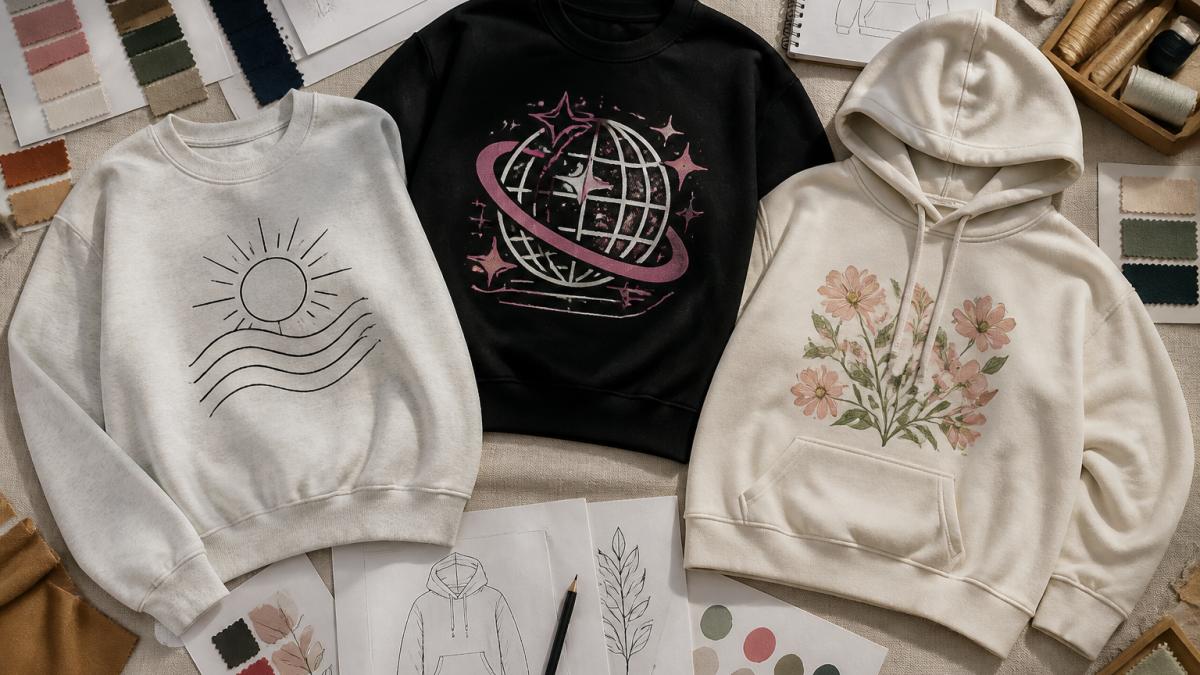
A custom graphic sweatshirt is a crewneck, hoodie, or quarter-zip decorated with a design you choose, text, artwork, a logo, or a photo. That design direction drives every decision that follows.
Minimalist and Typography-Driven Designs
Minimalist design is the safest bet for a sweatshirt you'll wear for years. A single word, short slogan, or monogram in a clean typeface reads as intentional rather than busy, and works on any garment color.
Typography carries the whole design, so font choice matters more than artwork. Serif faces feel classic, condensed sans-serifs feel modern, and hand-drawn lettering suits a sketchbook aesthetic.
Museum-inspired typography and simple text designs are having a moment because they photograph well and never look dated.
Bold Graphics, Y2K Style, and Streetwear Influences
Bold graphics reward people who want their sweatshirt to do the talking. Y2K style brings back chrome lettering, butterfly motifs, and playful gradients, while streetwear leans on oversized prints, collage texture, and illustration.
Common directions include:
- Y2K style: metallic type, stars, and early-2000s color palettes
- Streetwear: large back prints, small front logos, layered text
- Painting-inspired design: brushstroke textures and painterly florals
The trade-off is real: bold all-over prints cost more and date faster than a simple slogan. Pick one hero graphic and let it breathe.
How to Create a Custom Graphic Sweatshirt Design
Creating a custom graphic sweatshirt design starts with two decisions: the garment and the artwork. Here's the order we'd work in.
- Choose your garment style (crewneck, hoodie, or quarter-zip) based on how you'll wear it.
- Pick your design direction from the ideas above.
- Select your decoration method based on design complexity and quantity.
- Prepare your artwork file to the printer's specs.
- Order a sample before committing to a full run.
Choosing Your Garment Style: Crewneck, Hoodie, or Quarter-Zip
Crewnecks are the most versatile and easiest to layer, making them the default for group apparel and everyday wear. A hoodie adds warmth and a casual feel, while a zip hoodie or quarter-zip works better over a shirt.
For gifts, a crewneck in a neutral color is the safest choice because it suits almost anyone. Our CottonWorks fabric and garment guide is a useful reference for understanding how different fabric blends drape and wear.
Graphic Placement and Artwork Options
Placement decides whether a design looks custom or cluttered. The most common options are left chest, full front, full back, sleeve, and a small neckline or pocket detail.
A few common placement rules:
- Left chest suits logos and small text
- Full front suits a single bold graphic or slogan
- Full back suits large artwork, illustration, or a longer message
You can combine placements, but two is usually the limit before a sweatshirt feels busy. Decide the hero placement first, then add a secondary element only if it earns its space.
Best Sweatshirt Design Software and Tools for 2026
The best sweatshirt design software for most people is a free browser-based design studio, not professional illustration software. Online generators let you upload artwork, add text, pick fonts, and preview a mockup on the actual garment without installing anything.
Here's how the main categories compare:
Tool Type |
Best For |
Skill Level |
Cost |
|---|---|---|---|
Online design studio |
Quick custom orders, text and clipart |
Beginner |
Free with order |
Template libraries |
Ready-made layouts and slogans |
Beginner |
Free |
Canva-style editors |
Custom graphics from scratch |
Intermediate |
Free tier available |
Vector software |
Logos and print-ready artwork |
Advanced |
Paid license |
For a one-off gift, an online design studio with templates and free images is enough. Our Customize Your Sweatshirt Here option lets you pick the color, size, and design in one place, and we also take custom requests for special events and business needs.
Custom Sweatshirt Printing Techniques Compared
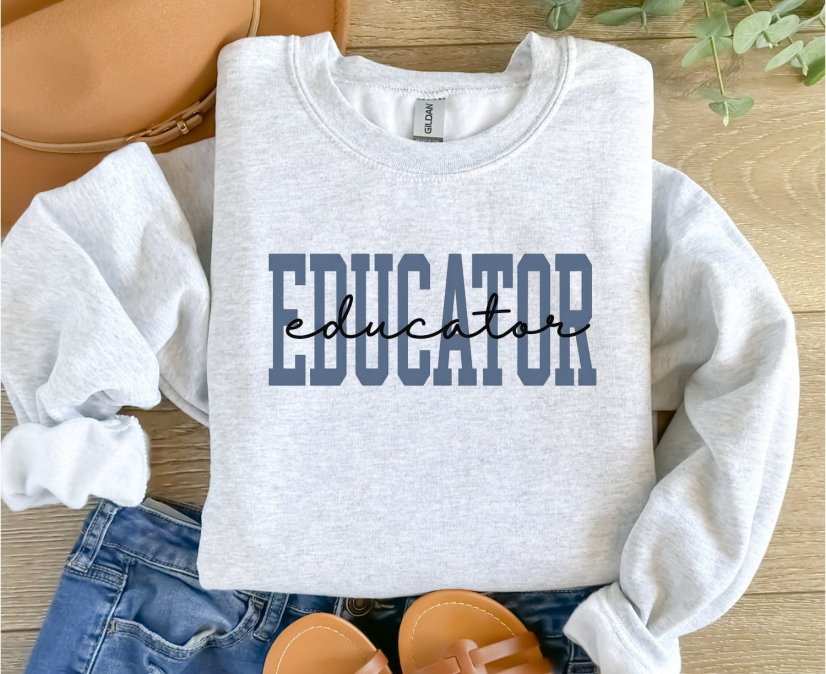
Custom sweatshirt printing techniques fall into four families: embroidery, screen printing, direct-to-garment (DTG) printing, and appliqué. Each changes how the design feels, how long it lasts, what artwork it reproduces, and how price scales with quantity. The right pick depends on your design's detail level, order size, and garment.
How Each Method Actually Works
Embroidery stitches thread into fabric using a digitized file, creating a raised, textured surface that survives repeated washing better than almost any surface decoration.
Screen printing pushes ink through a mesh screen onto the fabric, one screen per color.
Direct-to-garment (DTG) printing sprays water-based ink directly onto the garment like an inkjet printer. On 100% cotton it bonds well; on high-polyester or heavily textured fleece it can look faded or wash out faster, so confirm fiber content first.
Customize Your Sweatshirt Here →
Appliqué sews a cut fabric shape onto the garment, usually with a stitched border.
Matching the Method to the Design and Garment
The fastest way to choose is to work backward from your artwork and your quantity:
- Fine detail, gradients, or photos: DTG, or embroidery only if you simplify the art.
- Solid-color logo or slogan, 12+ pieces: screen printing.
- Small text, monogram, or name: embroidery.
Garment compatibility matters too. Heavyweight fleece and high-pile hoodies take embroidery well but can swallow fine DTG detail; smooth, tight-knit cotton crewnecks are the most forgiving surface for DTG and screen printing. For high-polyester blends, ask how the method behaves on that fabric before committing.
Method |
Best For |
Detail Limit |
Durability |
Cost Pattern |
|---|---|---|---|---|
Embroidery |
Logos, monograms, small text |
Low (no fine gradients) |
Very high |
Higher per piece, drops with volume |
Screen printing |
Bold graphics, slogans, large runs |
Medium (per-color) |
High |
Low per piece at volume |
DTG |
Photos, gradients, one-offs |
High |
Medium |
No setup, higher per piece |
Appliqué |
Textured, dimensional designs |
Low |
High |
Moderate, labor-intensive |
Preparing Artwork Files for Custom Sweatshirt Printing
Print-ready artwork is the biggest lever on whether a finished sweatshirt looks sharp or amateur. The rule of thumb: supply a vector file when you can, and a high-resolution raster file when you can't.
Vector vs. Raster: Which File Type You Need
A vector file (SVG, EPS, AI, or PDF) is built from math, not pixels, so it scales to any size without losing quality. Logos, text, and simple shapes should almost always be vector.
That relationship is the resolution math most people skip.
If you only have a low-resolution image, don't panic. The Adobe guide to print resolution and DPI explains why 300 DPI is the standard for print.
Color Modes, Backgrounds, and Fonts
Three settings cause most production surprises:
- Color mode: Design in RGB for screens, but know that print output is typically CMYK or spot color. Bright RGB colors (neon greens, electric blues) can shift when converted, so if exact color matters, specify it and ask for a proof.
- Background: Supply artwork with a transparent background, not a white box. A white rectangle behind your graphic will print as a white rectangle on a colored sweatshirt.
- Fonts: Convert text to outlines (or embed the font) so the printer's system doesn't substitute a different typeface and shift your layout.
A Pre-Flight Checklist Before You Send the File
- File is vector (SVG, EPS, AI, PDF) or 300 DPI raster (PNG, TIFF) at final print size [ ] Design is sized to the actual print dimensions, not the screen preview
- Text is converted to outlines so fonts don't shift
- Colors are specified, and you've confirmed the garment color they'll sit on
Proofing: The Step That Prevents Reprints
A proof is a preview of the design on the garment before production. Request one for anything beyond a single-color text design, and check three things: spelling, placement and size relative to the garment, and color against the fabric. Catching a typo on a proof costs nothing; catching it after a run of 24 is expensive. For group orders, have one decision-maker approve the proof.
Budgeting for Custom Graphic Sweatshirts: Order Size and Cost
Cost per sweatshirt drops as order size rises, because setup and screen or digitizing fees spread across more pieces.
The main cost drivers are:
- Decoration method: embroidery and appliqué cost more per piece than screen printing at volume
- Number of colors: more ink colors mean more setup for screen printing
- Garment quality: heavier fabric and premium blanks cost more
For a single gift, expect to pay for the garment plus a one-time setup. Our FTC guidance on accurate pricing and advertising claims is a good reminder to always confirm the final price, including setup and shipping, before you order.
A practical way to budget: decide your total spend first, then work backward to quantity. If your budget is tight, choose a single-color screen print on a mid-weight crewneck.
Frequently Asked Questions
What are some creative design ideas for custom graphic sweatshirts?
Creative ideas include minimalist typography with a meaningful phrase, bold Y2K-inspired graphics, floral prints, monograms, inside jokes for friend groups, and museum-inspired typography. You can also use collage textures, sketchbook marks, or painting-inspired designs. Think about the wearer's personality and interests, then choose a style that reflects them, whether that's a subtle monogram or a bold statement graphic.
How do I make a custom sweatshirt design?
Start by choosing a garment style like a crewneck or hoodie. Then select a design method such as embroidery, screen printing, or appliqué. Use design software or a design generator to create your artwork, or upload your own graphic. Prepare your file with the correct dimensions and color mode. Finally, place your order with a custom apparel provider, specifying size, color, and placement.
What is the best website to design sweatshirts?
The best website depends on your needs. Some platforms offer free templates and mockups, while others provide design studios with instant quotes. Look for a site that offers no minimums, free images, and the ability to upload your own artwork. Taylor's Expressions allows you to customize designs on sweatshirts, with options for different colors, sizes, and print locations.
What graphic sweatshirts are trending in 2026?
Trending graphic sweatshirts in 2026 include minimalist typography, bold streetwear-inspired graphics, Y2K-style motifs, floral prints, and holiday-themed designs. Personalized apparel with slogans, monograms, and inside jokes are also popular. Sustainable and inclusive fit options are gaining traction, as are designs that reflect personal values and positive outlooks.
Are there specific design styles that work best for embroidery versus screen printing?
Embroidery works best for simple, bold designs with clean lines and limited colors, such as logos, monograms, and text. Screen printing is better for complex, multi-color graphics, gradients, and detailed illustrations. For example, a detailed floral print with many colors is ideal for screen printing, while a simple slogan or logo is perfect for embroidery.
How can I make my custom sweatshirt design stand out?
To make your design stand out, focus on originality and personalization. Use unique typography, unexpected color combinations, or a design that tells a story. Consider placement, like a sleeve print or a back graphic. Also, choose high-quality printing or embroidery that won't crack or fade. Adding a personal touch, like a monogram or inside joke, makes it truly one-of-a-kind.
What should I consider when choosing a design for custom apparel?
Consider the wearer's style, the occasion, and the garment color. Think about the design's complexity and how it will translate to printing or embroidery. Also, consider the cost, order size, and turnaround time. For group apparel, ensure the design works for different sizes and fits. Finally, check the care instructions to keep the design looking new.
Designing a custom graphic sweatshirt shouldn't feel like a gamble, but too many shoppers end up with a print that cracks, fades, or never quite matches what they pictured. At Taylor's Expressions, we're a mom and daughter-owned shop built around helping you get it right the first time, with regularly updated designs, customizable colors and sizes, and free standard shipping on orders of $55 or more. Start with a design you love, and we'll help you make it yours.